Periodic Table of Elements - IUPAC | International Union of Pure and Applied Chemistry
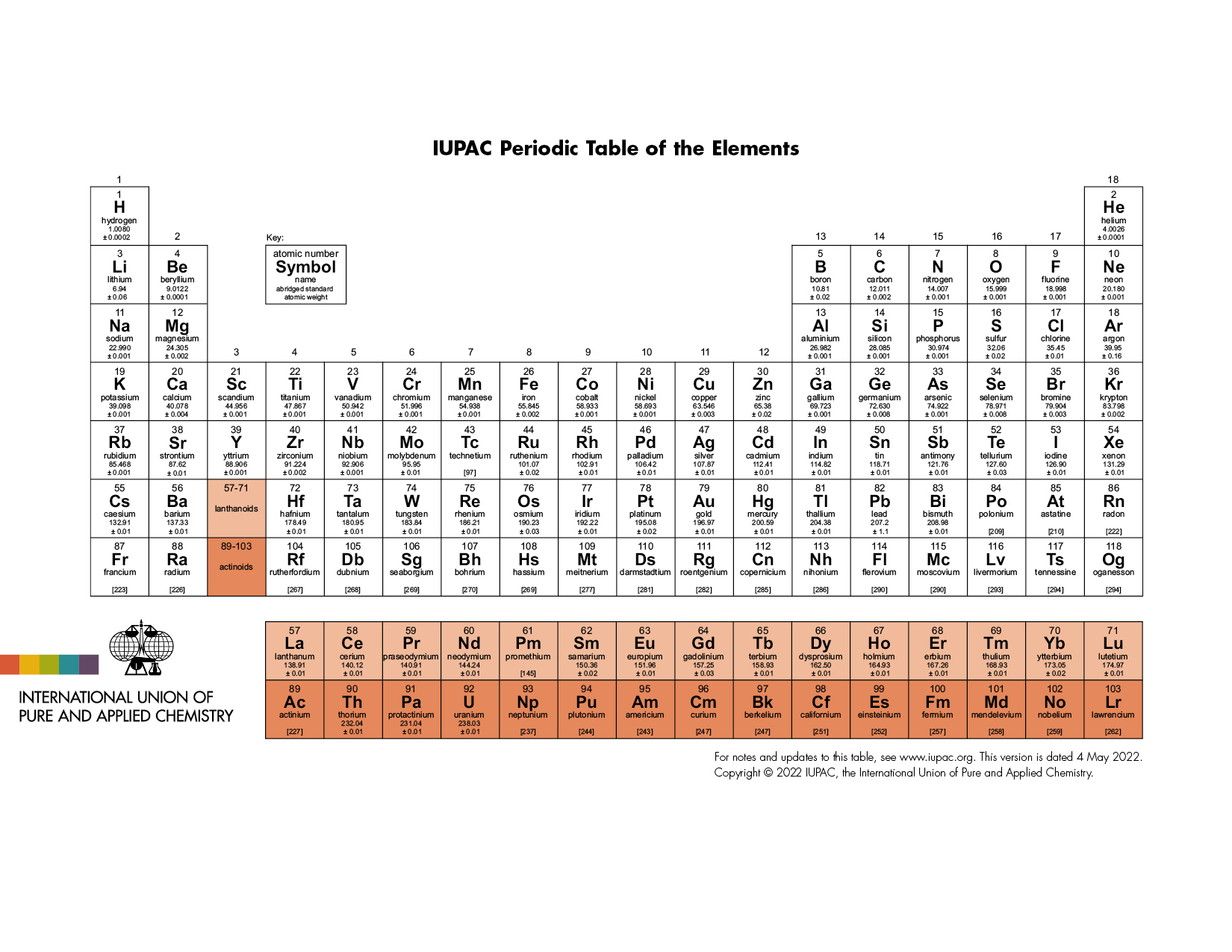
View the latest release of the Periodic Table (dated 8 Jan 2016) includes the recently added elements 113, 115, 117, and 118 with their temporary names and symbols
En bref
Ajouté le
17 mars 2026
Matière et domaine
chemistry · atomic-structure-periodicity
Niveaux scolaires
7e année–12e année (Terminale)
Type de page
Article
Introduction
IUPAC Periodic Table and Element Governance
- Latest Data: The current Periodic Table (released 4 May 2022) incorporates the "Standard Atomic Weights 2021" from the IUPAC Commission on Isotopic Abundances and Atomic Weights (CIAAW).
- Atomic Weight Notation: For elements lacking natural terrestrial isotopic abundance, the mass number of the nuclide with the longest confirmed half-life is provided in square brackets.
- IUPAC’s Core Responsibilities:
- Establishing criteria for the discovery of new elements.
- Defining temporary names and symbols for new elements.
- Validating discovery claims and assigning priority (often in collaboration with IUPAP).
- Coordinating the formal naming process, including a 5-month public review period.
- Setting nomenclature rules for new elements.
- Defining group structures (1–18) and collective names (e.g., lanthanoids, actinoids).
- Periodically reviewing standard atomic weights and isotopic compositions.
- Group 3 Debate: IUPAC is currently working to resolve the composition of Group 3, specifically whether it should contain (Sc, Y, Lu, Lr) or (Sc, Y, La, Ac).
- Terminology Standards:
- Groups: Recommended numbering is 1 through 18.
- Collective Names: "Lanthanoids" (La–Lu) is preferred over "lanthanide"; "Actinoids" (Ac–Lr) is the standard term.
- Historical Context: The CIAAW has been active since 1899 and currently operates under the IUPAC Inorganic Chemistry Division.
- Resources: IUPAC provides the table in various formats (PDF) and maintains an interactive version at iupac.org/isotopes-matter. Detailed technical reports and recommendations are published in the journal Pure and Applied Chemistry (PAC) and the magazine Chemistry International (CI).
Ci-dessous : site officiel et informations éditeur issues des fiches, avant d’ouvrir le site.
Avis de la communauté
Pas encore d’avis publiés. Soyez le premier à partager votre expérience.