Wave Interference - Interference | Double Slit | Diffraction - PhET Interactive Simulations
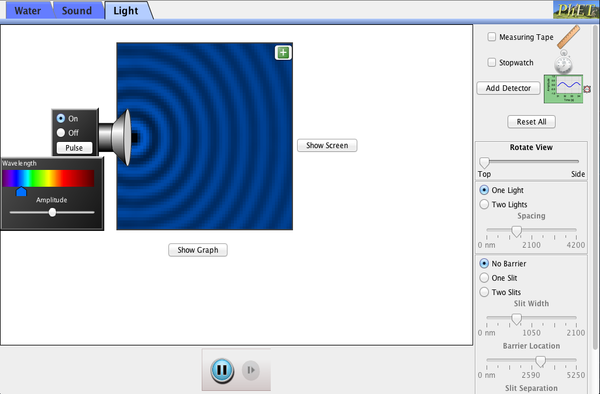
Make waves with a dripping faucet, audio speaker, or laser! Add a second source to create an interference pattern. Put up a barrier to explore single-slit diffraction and double-slit interference. Experiment with diffraction through elliptical, rectangular, or irregular apertures.
En bref
Ajouté le
18 mars 2026
Matière et domaine
physics · optics
Niveaux scolaires
9e année (3e)–12e année (Terminale)
Type de page
Tool
Introduction
Wave Interference Simulation Overview
- Core Topics: Wave interference, double-slit experiments, and diffraction.
- Media Types: Simulations cover water, sound, and light waves.
- Key Learning Objectives:
- Understanding the relationship between different wave types.
- Measuring wave speed through experimental design.
- Analyzing interference patterns generated by two sources.
- Identifying points of constructive and destructive interference using visual observation and digital detectors.
- Observing wave behavior through single and double-slit barriers.
- Mathematical Application: Predicting light fringe locations using the formula $d \sin(\theta) = m\lambda$.
- Experimental Variables:
- Impact of wavelength changes on diffraction patterns.
- Impact of aperture size and geometry on diffraction patterns.
- Verification of predictions using built-in measurement tools like the tape measure.
Avis de la communauté
Pas encore d’avis publiés. Soyez le premier à partager votre expérience.