Periodic Table of Elements - IUPAC | International Union of Pure and Applied Chemistry
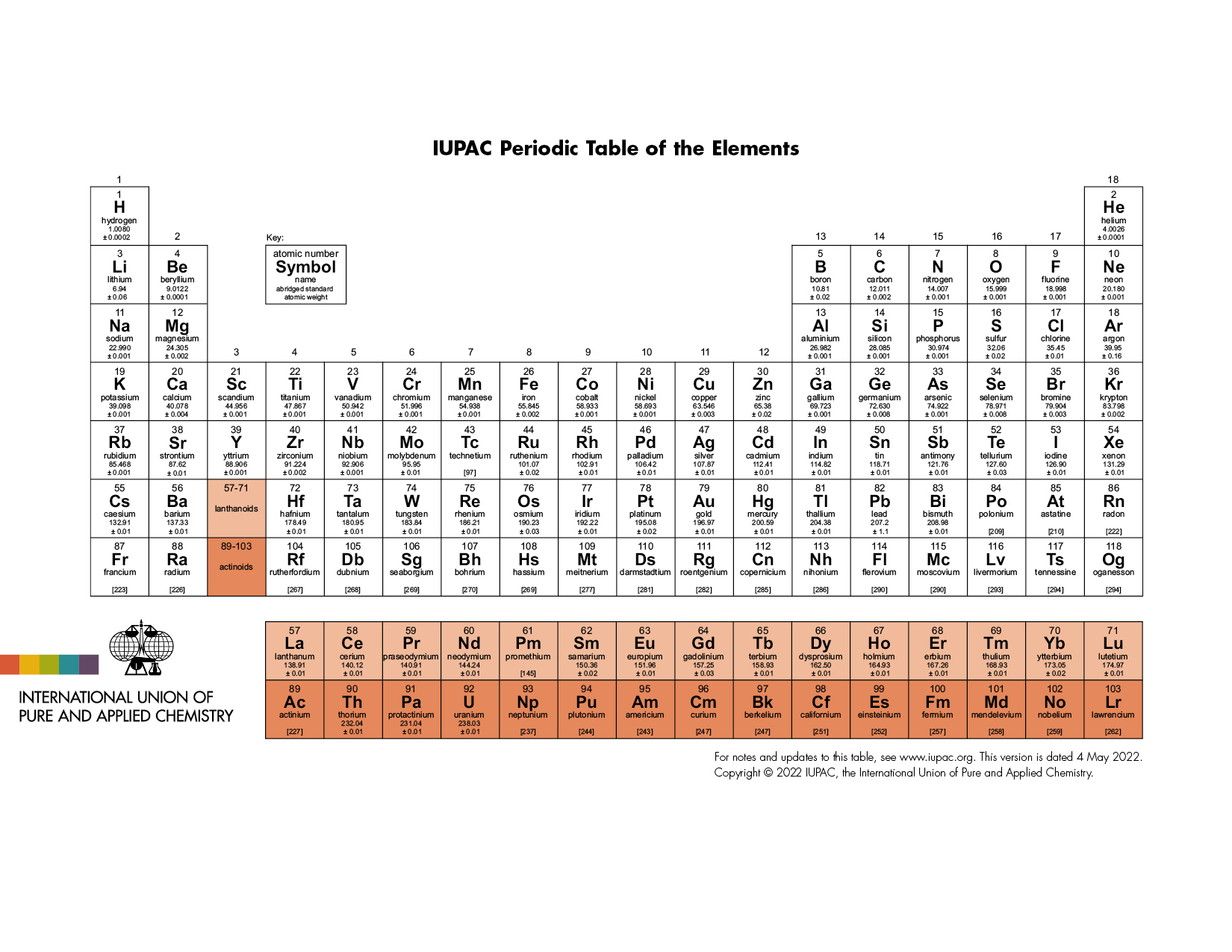
View the latest release of the Periodic Table (dated 8 Jan 2016) includes the recently added elements 113, 115, 117, and 118 with their temporary names and symbols
Overview
Added
March 17, 2026
Subject & domain
chemistry · atomic-structure-periodicity
Grade range
Grade 7–Grade 12 (Senior)
Page kind
Article
Introduction
IUPAC Periodic Table and Element Governance
- Latest Data: The current Periodic Table (released 4 May 2022) incorporates the "Standard Atomic Weights 2021" from the IUPAC Commission on Isotopic Abundances and Atomic Weights (CIAAW).
- Atomic Weight Notation: For elements lacking natural terrestrial isotopic abundance, the mass number of the nuclide with the longest confirmed half-life is provided in square brackets.
- IUPAC’s Core Responsibilities:
- Establishing criteria for the discovery of new elements.
- Defining temporary names and symbols for new elements.
- Validating discovery claims and assigning priority (often in collaboration with IUPAP).
- Coordinating the formal naming process, including a 5-month public review period.
- Setting nomenclature rules for new elements.
- Defining group structures (1–18) and collective names (e.g., lanthanoids, actinoids).
- Periodically reviewing standard atomic weights and isotopic compositions.
- Group 3 Debate: IUPAC is currently working to resolve the composition of Group 3, specifically whether it should contain (Sc, Y, Lu, Lr) or (Sc, Y, La, Ac).
- Terminology Standards:
- Groups: Recommended numbering is 1 through 18.
- Collective Names: "Lanthanoids" (La–Lu) is preferred over "lanthanide"; "Actinoids" (Ac–Lr) is the standard term.
- Historical Context: The CIAAW has been active since 1899 and currently operates under the IUPAC Inorganic Chemistry Division.
- Resources: IUPAC provides the table in various formats (PDF) and maintains an interactive version at iupac.org/isotopes-matter. Detailed technical reports and recommendations are published in the journal Pure and Applied Chemistry (PAC) and the magazine Chemistry International (CI).
Official site and publisher details from listings appear below before you open the site.
Community reviews
No published reviews yet. Be the first to share your experience.